Introduction
Two years ago over winter break, shuffling around dusty board games and vacation scrapbooks, I unearthed a childhood project my younger brother made. Asked to identify his future job, Daniel scribbled film director in blue Crayola marker. I swear, making movies, telling stories, flows through certain people like blood cells. Dan just knew. More than a decade later, accepted to study screenwriting at Ithaca College, I asked him by phone to define “indie filmmaking.” He presented a nostalgic and rather rigid answer. Dan said, sounding sort of grandfatherly, “You know, indie films used to involve cheap cameras, casting friends, shooting around town. Now a multi-million dollar movie might still count as indie. I think that is wrong.”
While a pretty bare-minimum interpretation, as always my sibling makes a solid if controversial point. Ultra high-definition cameras and A-list actors complicate notions of authentic independence. What qualifies as indie anymore? As much as literally being a movie produced outside the traditional studio system, I contend that indie describes a particular aesthetic, price point, narrative form and cinematic technique. In this paper, I journey back twenty-eight years and sprint across time, illuminating and analyzing six turning points that influenced how Americans today understand indie filmmaking. Relying primarily on trade press articles and popular literature, I attempt to open a window into indie subculture, an outsider movement historically defined in opposition to Hollywood. Yet within independent cinema a civil war rages. Netflix and Amazon, tech giants with loads of liquid cash, spent exorbitant sums last year to acquire prestige Sundance pictures. Meanwhile, small companies and media conglomerates alike are teaming up military-style, establishing perimeters, organizing counter-attacks, preparing themselves as titanic forces join the indie film industry.
Instead of jumping in head-first, I should really outline this ambitious endeavor. First, we cover what cinema historian Peter Biskind called the “big-bang like moment” for indie filmmaking (2004, p. 26), when Steven Soderbergh debuted sex, lies, and videotape at the 1989 Sundance Film Festival. Second, we examine how Bob and Harvey Weinstein, the dynamic duo behind Miramax, transitioned from Queens rock-and-roll promoters to industry titans. Third, we evaluate how Hollywood maneuvered a deregulated media environment to establish indie divisions of their own. Fourth, we jump ahead a decade, to 2006, when a charming indie comedy flick, Little Miss Sunshine, amassed a remarkable hundred-million dollar box office, inspiring in the process a generation of imitators. Fifth, we question what Netflix and Amazon could gain from distributing indie films. And finally, we will profile A24 and Annapurna Pictures, two exciting upstarts eager to shake things up. Before doing so, however, we should expound further a definition of “indie.” What traditionally differentiates an indie movie from a Hollywood movie? How are indie movie viewers distinct from national film audiences?
Defining “indie”
Independent films, fundamentally, orient themselves in opposition to studio-made movies. Successful independent cinema take risks and push boundaries in ways Hollywood insiders might consider outlandish. Indie means alternative in many ways, as New York University Associate Professor Emmanuel Levy writes, “made uncompromisingly, often on shoestring budgets” (p. 23). These films involve ambitious, original storytelling, quirky directorial choices, and cost-conscious casting. They avoid “cookie-cutter decision making,” and universally prioritize creating quality entertainment over generating mega-blockbuster returns. In her ethnographic study of American indie filmmaking, Sherry Ortner calls indie a “critical, cultural movement” (2011). Many films we will analyze later frame themselves around this description: niche, specific, and human.
Technically and stylistically, indie films run against the Hollywood grain. That defines them. Except, not always. Ironically, indie filmmakers created Hollywood. They wanted to escape an overzealous, monopolistic inventor named Thomas Edison. You probably have heard of him. In addition to inventing electric light bulbs and phonographs, Edison possessed a hefty patent portfolio that covered projectors, cameras, and film stock, enabling him to assert anti-competitive “quality control” over motion picture production (Lasar, 2010). To circumvent Edison, a bunch of moguls – theater operators, cartoonists and other creatives – rode westward to sunny southern California. They settled down in a hilly area, where they hoped their craft could be developed and refined, free from outside interference: Hollywood.
Returning to present, Levy characterizes indie film audiences as unwaveringly loyal, highly educated baby-boomers (1999, p. 28). Although indies remain movies targeted at specific audiences, such as college students, childless couples, art snobs, and frequent moviegoers, many mainstream filmmakers began as indie auteurs (p. 29), and vice versa. Often intimate stories, proper indie dramas and unconventional indie comedies, experience inexplicable national success. Little Miss Sunshine, which we will be exploring later, is an apt example. My brother frequently reminds himself that Quentin Tarantino conceived his first script, From Dusk Till Dawn, while working full-time in Manhattan Beach as a video store clerk. His follow-up screenplay, Reservoir Dogs, about a jewelry heist gone awry, premiered at Sundance to critical acclaim in 1992, cementing Tarantino as an indie filmmaker worth watching.
Sundance: Authentic storytelling incubated in Utah
The Sundance Film Festival takes place annually in Utah, showcasing innovative work by American and international movie-makers. Robert Redford chairs the Sundance Institute, which in 1984 assumed management over the fledgling program. Rules were loosened. They moved from Salt Lake City to Park City. Within a few years, Sundance would turn around. How? A debut film from twenty-six year old Steven Soderbergh. Industry historian Peter Biskind describes sex, lies, and videotape as “the first Gen-X picture, taking shots at the predatory, suspender-wearing, Reagan-era yuppie” (2004, p. 41). The $1.2 million feature about an emotionally unfulfilling marriage skyrocketed Soderbergh and validated Sundance as an exhibition venue and talent incubator. Renowned film critic Roger Ebert took to calling Soderbergh, a future Academy Award-winning director, “Sundance’s poster boy.” Sundance gave a generation of future auteurs a platform to exhibit their work, including Tarantino, Jim Jarmusch, David O. Russell, Darren Aronofsky, Paul Thomas Anderson, and Kevin Smith. Even so, festivals like Sundance are more than “nodes in a distribution circuit,” as Newman (2011) writes, they “give artists the incentive to create and cultivate an audience” (p. 67). According to Newman, those years immediately following sex, lies saw consistent attendance growth and an incredible leap in prospective participants.
Miramax: An outsider breaks through
To borrow an illustrative comparison from Peter Biskind, author of Down and Dirty Pictures, if Sundance is like a “finishing school,” teaching young filmmakers to “dress for success,” then Miramax is “the reform school where they are cuffed and cudgeled into shape” (2004, p. 26). Biskind describes them as “yin and yang of the indie universe, the high road and the low, the sun and the moon, Luke Skywalker and Darth Vader” (p. 26). Harvey and Bob Weinstein formed Miramax ten years before distributing sex, lies, and videotape. Back then, Biskind writes, they were “bottom-feeders, trolling for movies.” Every picture deserved an advocate, and with the Weinsteins you could get two. Their strategy was the same as every distributor, to take gross revenue. But their corporate culture was entirely distinct. “It was the brothers and then everybody else,” writes Biskind (p. 63). “The beauty of Miramax was that when everything was going right, it offered the best of both worlds, giving the films the tender loving care indie distributors excelled at and spending big money buying TV spots” (p. 82).
Indiewood: On industry deregulation
The major Hollywood studios reacted forcefully to the growing popularity of independent films. They developed in-house arms to cultivate the same style and aesthetic that the indie companies created. Miramax was bought out by the Walt Disney Company for $60 million in 1993, but the Weinsteins maintained leadership there until 2005. Bob and Harvey wasted no time before creating their own production company, The Weinstein Company. Contemporaneous to the 1993 Miramax deal, Ted Turner purchased New Line Cinema and Castle Rock Entertainment, producer of When Harry Met Sally and A Few Good Men. Jennifer Holt, a media industry specialist at University of California Santa Barbara, makes an excellent point as to how industry deregulation allowed for such consolidation across the media spectrum. She describes the Telecommunications Act of 1996 as the “ultimate deregulatory initiative” (2011, p. 165). A few key committee leaders were replaced during the 1994 midterm elections, notably then Representative Ed Markey of Massachusetts, chair of the House Telecommunications Committee. Holt describes the rhetoric surrounding the bill at that moment as reversing from “access, fairness, and reigning in big media to privileging market forces and deregulation” (p. 164). So what was in the bill and how did allow Hollywood to create Indiewood, their version of indie filmmaking? It “eradicated a host of legally imposed structural divisions between industries,” writes Holt, “allowing broadcast, cable, and telephone companies to create convergent media empires with newly expanded boundaries” (p. 166). Concurrent to this political reform, Sony and Fox decided strategically to form new divisions dedicated to indie filmmaking. Sony formed Sony Pictures Classics for this expressed purpose in 1992. Fox established Fox Searchlight a year later with a similar idea. One of their biggest hits, besides Slumdog Millionaire which grossed $370 million in United States box office receipts, was Little Miss Sunshine, the Sundancefan-favorite which they purchased distribution rights for in 2006.
Little Miss Sunshine: The copycat conundrum
It almost never got made. Nobody wanted to take a chance on the $9 million so called “indie” film directed by a middle-aged team of first-time directors, without a big-name movie star. Focus Features, the indie distribution company owned by NBCUniversal, helped fund the project for two years before deciding the investment was too great, at which point producer Marc Turtletaub bought back the rights to Sunshine for 400 thousand dollars. He recalls saying, as written by The New York Times, “You know what? We’ll stick our neck out. I’m willing to take a risk on a movie that is there to uplift and enlighten” (Waxman, 2006). All in all, it took five years to make. But it appeared at Sundance and was a hit.
Ever since the film has been a point of comparison for other good-hearted indie movies only looking to please. Just look at this Buzzfeed headline from January 2013:
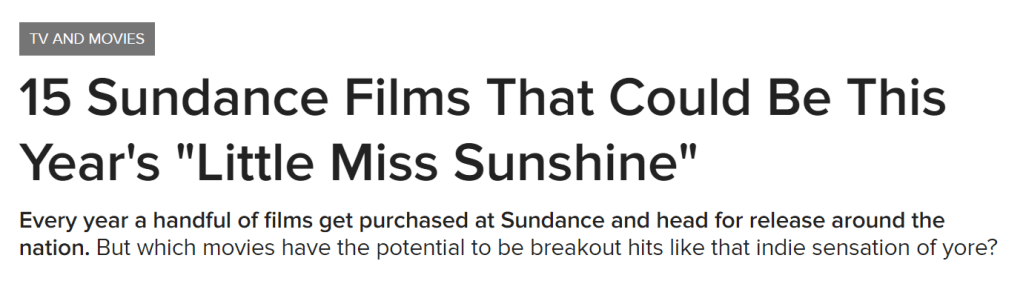
Their predictions were mostly off point. They gave Austenland starring Keri Russell 2 to 1 odds. It wound up grossing barely over $2 million and receiving rotten reviews. Anyway, so why was Little Miss Sunshine successful? A quirky family on a road trip making fun of beauty pageant culture in America – of course it was successful. All the right ingredients. The question has become, rather, why are so many writers trying to imitate its success to no avail? Just see Captain Fantastic from last year. Viggo Mortensen was nominated for it. It was well liked. But much fewer people saw it then Sunshine. Ultimately, what we are seeing here is Hollywood culture seeping into indie culture. Remaking, adapting, spin-offs are all unlikeable techniques. Only true, authentic, original stories will succeed in the cut-throat chambers of indie cinema.
Netflix and Amazon: Tech giants join the fray
Why is independent filmmaking a suitable hunting ground for Netflix and Amazon, two tech giants? Well, both are trying to expand their streaming services. Both are incredibly wealthy companies with millions of paid subscribers around the world. Netflix is a premium monthly subscription service. Amazon Prime is basically a necessity for American households who shop online. So they have all this disposable income. That is the first thing. Then, secondly, indie movies cost less than going all-out, green-screen, special effects heavy, super-hero action ensemble drama. If well advertised, marketed to the right audience weeks in advance, people will watch. So they do as they did this past year. Amazon Studios co-distributed Manchester by the Sea, written by Kenneth Lonergan. Casey Affleck won best actor for his performance (Bart, 2017). But take note that Amazon opted for a theatrical release. I saw it. It was a depressing movie. But I did see it.
Netflix, according to recent reports from The Hollywood Reporter, could be boxed out from future film festivals for failing to show their scoops theatrically. Cannes, just the other day, stipulated in a statement that future festival participants must commit to exhibiting their films in French movie theaters. In a sort of political metaphor, Netflix chief-executive Reed Hastings called Cannes “the establishment closing ranks against us” (Roxborough, 2017). The statement by Cannes is quite interesting. “The festival is excited to welcome a new operator,” it reads, “which has decided to invest in cinema.” The art crowd looks at Netflix and Amazon like they are in over their heads. But they know exactly what they are doing: boxing everybody else out.
A24 and Annapurna: Movers and shakers
Lastly, we arrive at a couple of companies offering something different, two up-and-coming indie companies with a cultivated youth following, savvy social media presences, and a distinct aesthetic from seemingly everybody else on the map. Annapurna Pictures came first in 2011 At twenty-five years old, Megan Ellison, daughter of another tech titan, Oracle founder Larry Ellison, used a few hundred million dollars gifted to her by her father to create Annapurna Pictures, named after a north-central Nepali mountain range. The New York Times described her launch onto the indie scene as a “remarkable surge” (Cieply & Barnes). Since throwing production funding behind a near unrivaled pair of indies that year, The Master and Zero Dark Thirty, Annapurna has ventured into video games and television series. In 2012, two of its movies, Spike Jonze’s Her and David O’Russell’s American Hustle, were nominated for Best Picture. Down the road are follow ups from Paul Thomas Anderson and Kathryn Bigelow, as well as a Wes Anderson stop-motion animated comedy.
That same year, A24, arose on the scene, backed by capital infusion from Guggenheim Capital. Unlike Annapurna, A24 would spend years as a film distribution company before moving onto the production side last year with Moonlight, on which I have more to say later. In his lengthy profile of the uber-secretive A24, Salon’s David Ehrlich prophetically predicted that film historians would cite A24’s work as the reason for how “the film industry crawled out of its deathbed and back onto its feet” (2015). Deep downtown in Manhattan are the A24 offices. Ehrlich got the inside look at the company which very few have been able to see. Almost everyone working there is under 40, writes Ehrlich. Their films are budgeted anywhere from 1 to 20 million dollars, they might feature a prominent star, but often choose to cast them in roles which subvert their public persona. And from viewing a host of their suite myself, I agree wholeheartedly with his conclusion:
At a time when young people are increasingly going to the movies only for blockbuster spectacle, A24 has established itself as the film industry’s most forward-thinking company by releasing the kind of midsized, stylish, quality films that seemed on the verge of going extinct, transforming them into a collective theatrical experience, and aiming them squarely at a demographic that would rather watch movies on their phones. It’s not remarkable that A24 had set such a goal—it’s remarkable that the company is accomplishing it.
Moonlight: Oscars surprise win could further complicate what indie filmmaking is, or maybe not
Nobody expected Moonlight to win this February. It was perceived too ambitious. A coming-of-age story about a gay black man growing up on Liberty City, Miami? But A24 thought otherwise. It was approached with unparalleled delicacy and affection from its filmmaker, Barry Jenkins, who lived the story of Chiron, its protagonist. What does Moonlight’s victory suggest about the constantly changing definition of indie filmmaking? Well, aesthetically and narratively, we will see copycats, people trying to replicate its success for financial gain. To follow through on our other indie flashpoints, at this point we have basically seen Miramax fold. Harvey and Bob are holding strong, however. Industry consolidation is less an issue today as new competition from Netflix and Amazon, who are eating Sundance dry of the next generation of indie filmmakers. Indiewood departments, meanwhile, like Fox Searchlight, Sony Classics, and Focus Features, remain potent forces at awards. I suppose I would tell my brother, who is confident he will be successful in this indie filmmaking steel cage battle, to commit to stories that matter. No matter how much money you spend on marketing, no matter how unknown you are, how little you spend on your movie – Moonlight cost only $1.6 million – if you create something truly unique, something like Moonlight, that appeals to young people and speaks to the current cultural moment, you will survive just fine in this cutthroat industry.
 Matt Schwartz